tirsdag den 28. juni 2016

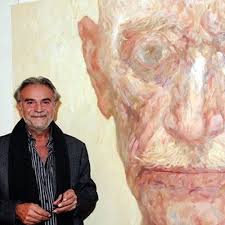
Omar Hamdi .... Malva


Omar "Malva" Hamdi is a Syrian Kurdish artist. Born in 1951 in AI-Hasaka, Syria, he worked as a graphic artist for the Syrian Press, where he also wrote articles an Artistic Criticism. He settled in Vienna since 1978 and now holds the Austrian Nationality, is a member of the General Federation of Austrian Artists and the UNESCO, and a member of the Künstlerhaus - Wien. His works of Art are widely exhibited in several art Galleries, including in particular, Arnot Gallery New York, which acts as a representative of his works.
His works are acquired by art collectors and dealers, art galleries and exhibitions, museums, banks and Ministries of Culture, in addition to a large number of private collections in America, Canada, Austria, Germany, France, Italy, Holland, Japan, Sri Lanka, and Russia.
His life is devoted to full-time artistic work.


Omar Hamdi past away 2015.


onsdag den 8. juni 2016

Mohammad Bozorgi


Born in Tehran in 1978, Bozorgi was originally educated as a biomedical engineer before entering the visual arts with a decade of training at the Society of Iranian Calligraphers, where he mastered a number of calligraphic forms, and earned ‘Momtaz’ degrees. This robust background has inspired Bozorgi to use the directives of geometry to create abstract illusions of depth and space while developing stylised characters based on Arabic and Persian examples.

Recognised as a leading figure among a ‘New Generation’ of contemporary calligraphers, Bozorgi builds on the breakthroughs of modern predecessors, as he seeks to advance the art of calligraphy through experimental formalism. Within his meticulously designed compositions, text multiplies as it is infused with energy and appears to move across the canvas or paper in unison, originating from and returning to the center like the cyclical rhythms of nature.


Ayyam Gallery Beirut

Beirut Tower, Ground Floor,
Zeitoune Street
Solidere
Beirut, Lebanon
 
Phone: +961 1 374450/51
Fax: +961 1 374449
Email:
beirut@ayyamgallery.com
 
Monday- Friday | 10AM - 8PM
Saturday | 12PM - 6PM
Closed on Sunday


torsdag den 26. maj 2016


Tammam Azzam
Born in Damascus, Syria in 1980, Tammam Azzam received his artistic training from the Faculty of Fine Arts, University of Damascus with a concentration in oil painting. Alongside a successful career as a painter in Syria, Azzam was a prolific graphic designer, an experience that would inform his digital media work after relocating to Dubai with the start of the country’s conflict.


The initial phase of Azzam’s work was distinguished by a ‘hybrid form’ of painting with applications of various media that allowed him to arrive at tactile interactions between surface and form that multiply as compositions evolve. These semi-abstract works use unconventional materials such as rope, clothespins, and other found objects in order to accentuate the depth, texture, and space of laboured picture planes, creating a visible tension. Although outwardly different in appearance, the series that resulted from these early experiments were inspired by the artist’s changing perceptions of specific urban environments.


Following the start of the uprising in Syria, Azzam turned to digital media and graphic art to create visual composites of the conflict that resonated with international viewers. These widely distributed works are informed by his interest in the interventionist potential of digital photography and street art as powerful and direct forms of protest that are difficult to suppress. In early 2013, Azzam made worldwide headlines when his Freedom Graffiti print went viral on social media.


Recently, he has returned to painting with Storeys, a series of monumental works on canvas that communicate the magnitude of devastation experienced across his native country through expressionist compositions of destroyed cityscapes. Chronicling the current state of his homeland, Azzam delves into a cathartic exercise of reconstruction, storey by storey. Alongside these new paintings, he has produced a significant body of giclée prints and installations that depict the facets of cities through similar themes.


Azzam has contributed to large-scale international exhibitions such as the FUU-Street Art Festival, Sarajevo (2015); Vancouver Biennale, where he was in residence (2014); FotoFest Biennial (2014), Houston; Dak’Art: Biennial of Contemporary African Art, Dakar (2014); Alexandria Biennale (2014); and the 30th Biennial of Graphic Arts, Ljubljana (2013).


In recent years, Azzam has participated in solo and group exhibitions at such venues as Künstlerverein Walkmühle, Germany (2016); Columbia University, New York (2016); Ayyam Gallery - 11 Alserkal Avenue, Dubai (2016); Banksy’s Dismaland, Weston-super-Mare, United Kingdom (2015); Fondazione Giorgio Cini, Venice (2015); Framer Framed in de Tolhuistuin, Amsterdam (2015); Forum Factory, Berlin (2014); Lena & Roselli Gallery, Budapest (2014); Liquid Art House, Boston (2014); Rush Arts, New York (2014); Busan Museum of Art, Seoul (2014); 1x1 Art Gallery, New Delhi (2014).


In 2016, Azzam received an artist fellowship at the Hanse-Wissenschaftskolleg Institute for Advanced Study in Delmenhorst, Germany. 


Hazem Alhamwi


Hazem Alhamwi (Damascus, 1980) is a director and producer from Syria, currently living in Berlin. He started his artistic career as a painter, having studied Painting at the Faculty of Fine Arts. After participating in a few exhibitions on comics art, he decided on a slight career switch and enrolled in the High Academy of Theatrical Arts, where he discovered his love of cinema. The Arab Institute for Films was the starting point of his life as a filmmaker and producer.


Preben Hornung, 22.7.1919-3.8.1989, painter.


He visited both kunsthåndværkerskolen and the Art Academy in Copenhagen, in some years in the 40s, he went with K. Iversen and A. Jørgensen, but he found himself not in the correct place and characterized the later years at the Academy as "wasteful". The debut took place at the artists ' autumn exhibition in 1947. At the time cultivated Preben Hornung realistic motifs, landscapes, Garden pictures, interiors with figures and scenes from the city's outskirts, etc., and the method of painting was greatly influenced by the French late impressionism, especially Pierre Bonnard. 


A radical turnaround in the mode came in 1948 when he painted on the steel strip mill in Frederiksværk. From now on, the pictures were abstract constructive and based on a highly simplified colour grouped around the black/white. In the early 1950s  softened the straight constructive style, and a greater pictoresque expansion occurred after he found Langebro as motif, later played an railway booms and crossings in his motif, and the picturesque world language freede gradually, to motive mapping almost fell out altogether in the ' 60s, and development then moved around a lyrically picturesque language with much more finicky and limited use of shapes and colors.


From 1977 began Preben Hornung to paint portraits, and among his 30 portraits he painted, among other things portraits of Queen Margrethe II, 1981, 1983 and 1985.

In addition to great diligence on the painting area put Preben Hornung much emphasis on exploiting his talent in other visual art forms. Something of a breakthrough work was the great stained glass (12 x 14 m) which he made to sugar mills by refineries, administration building in Copenhagen in 1958, but besides this made Preben Hornung, a number of other decorations, stained glass at the technical school, Tomsgårdsvej, Kbh., 1966-67 and Haderslev katedralskole, 1973, a mosaic of Skanderborg municipality school, 1969, as well as picturesque decorations: City Hall of Rødovre Town Hall, 1959, student House at Aarhus University , 1964 (moved 1973) and frederiksværk County high school as well as several others.


Another important field of activity for Preben Hornung was scenography. From the mid-' 60s, he worked diligently with decorations for the theatre performances as Salome and Boris Godunov (both the Royal Theatre, 1966) and The marvelous mandarin (the Royal Theatre, 1967) as well as a host of other performances. For Dario Fos archangels never makes a contrivance (Gladsaxe Theatre, 1970) made h. decorations that prompted the critic Jens Kistrup to name him "the country's fanciest and most flexible Theater painter".
On the exhibition front selected Preben Hornung also his extensive artistic activity, among other things. by retrospective exhibitions in the Funen art museum Odense 1966 art and Art Association in Kbh. 1976, but it has also been to numerous exhibitions abroad. Preben Hornung is bulky represented in our art museums and public collections.


Franciska Clausen


Franciska Clausen, 7.1.1899-5.3.1986, painter. Born and raised in Aabenraa as the city was German, received his artistic education in Germany 1916-17 where she studied in Weimar at the Grossherzogliche Kunstschule, and 1918-19 at Frauenakademie in Munich. 1920, she came to the Academy of fine arts in Copenhagen.


After these studies she came in closer contact with the contemporary modern art when she studied in His 1921-22 Hofmanns atelier in Munich, and even more so by Laszlo Moholy-Nagy acquaintance with, one of the constructionist art leaders. In Munich she had already 1921 painted spontaneistiske, abstract watercolors, now she worked under Moholy Nagys-guide with constructionist exercises and paintings in a sober, simple, realistic style. From 1924-25, she worked in Paris at the Académie Moderne Léger Fernand, and his art had a decisive influence on her work, though her photos are less figurative than learn the master's.


1924 exhibited Franciska Clausen with Otto Carlssund and Erik Olson in Paris at an exhibition of Playing and his Scandinavian students. Towards the end of the twenties she received impulses from the abstract, "neoplasticistiske" direction and exhibited with the group "Cercle et Carré 1930" which, inter alia, Piet Mondrian was participating. A separate exhibition she got first 1932 in Copenhagen.


When Francisk Clausen not during her stay abroad had her own Studio, many of her visual art ideas only maintained in gouache and water colours while the paintings with these motifs in the 1950s and 1960s was to first. For many years worked Francisk Clausen in Åbenrå isolated from the Danish artistic life with the execution of the portrait bookings as bread work. A retrospective exhibition of her work in 1962, organized by the Sydslesvigs Danish art society, and Art Association Exhibition of her paintings and gouaches 1964 created a new interest in her art. She received the Tagea Brandt 1966 scholarship and from 1974 a scholarship from the Danish Arts Foundation, from the 1979 lifetime performance.


Artwork by Franciska found, among other things. in The Royal engraving collection, Aarhus Kunstmuseum, Skive museum, Tønder museum, Åbenrå museum, Funen art museum of art, the Museum at Sønderborg Castle, Trapholt Museum of, which has a separate Department with her works, ARoS. Decorating: Mosaic on the town square in Albertslund (the Danish Arts Foundation). Portraits, inter alia, in the people's home, Åbenrå. Portrait of Queen Margrethe II, 1977, Queen Ingrid 1980
.


The article derives from 3. Edition of the Danish biographical lexicon, published 1979-84.